
The Chemistry behind Semiconductor Manufacturing
This post will expand on my last post on the step by step manufacturing processes of semiconductors.

In my previous post, we were introduced to semiconductors—the critical components behind electronic devices. Here, we delve deeper, exploring the semiconductor manufacturing process in detail. From raw silicon to complex microchips, each step involves precision, sophisticated chemical processing, and advanced materials science.
In an age where semiconductors keep evolving and becoming more advanced, the need for perfection keeps on increasing to the nth degree. Due to this it becomes vital that the manufacturing processes evolve with this, but how? In the last post we learnt about some important materials and processes in used in semiconductor manufacturing. In this one we will understand the step by step manufacturing process of semiconductors.
1. Silicon Production
Everything begins with silicon, it is by far the most important material in semiconductors, but before it becomes useful material it needs to be purified. Silicon is abundant in the Earths crust, but it is found in the form of silica(SiO2).
Silicon is first purified by heating silica with carbon in a furnace at temperatures above 2000 °C. The above reaction forms silicon which is about 99% pure, which is still not pure enough to be used in electronic devices.
To further purify the silicon, the Siemens process is used. In this process ground silicon is reacted with HCl at 300 °C to form trichlorosilane gas(SiHCl3). Finally, the purified trichlorosilane is decomposed and produces high-purity polycrystalline silicon rods, the HCl is released as a byproduct. These super pure polycrystalline rods are electronic grade pure(99.999999% pure) and are ready to be used.
2. Crystal Growth and Wafer Formation
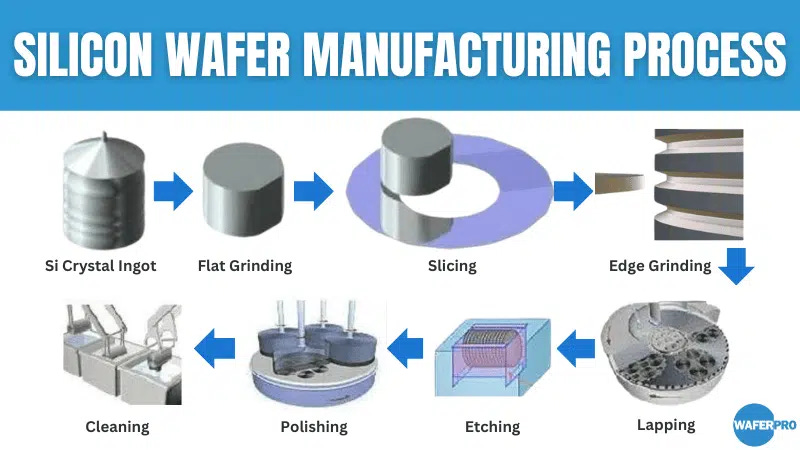
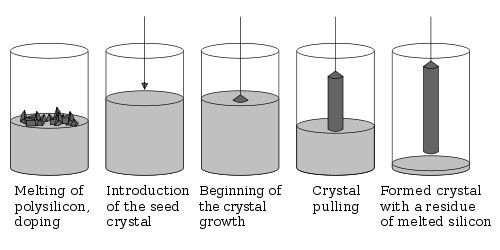
Microchips require a single crystal silicon, and not polycrystalline silicon. This is achieved by the Czochralski(CZ) method. In the CZ process, a large quartz crucible is filled with high-purity polycrystalline silicon and heated in a vacuum to above silicon’s melting point (≈1414 °C). A small seed of silicon is then dipped into the molten silicon. It is then pulled upward slowly while rotating, this allows the molten silicon to solidify onto the seed forming a cylindrical single crystal.
Once this is done, the silicon ingot is then ground and cut into smaller lengths. It is then doped into either p or n type silicon, to create resistivity or conductivity. After this it is sliced into thin disks to create wafers.
3. Wafer Polishing and Surface Preparation
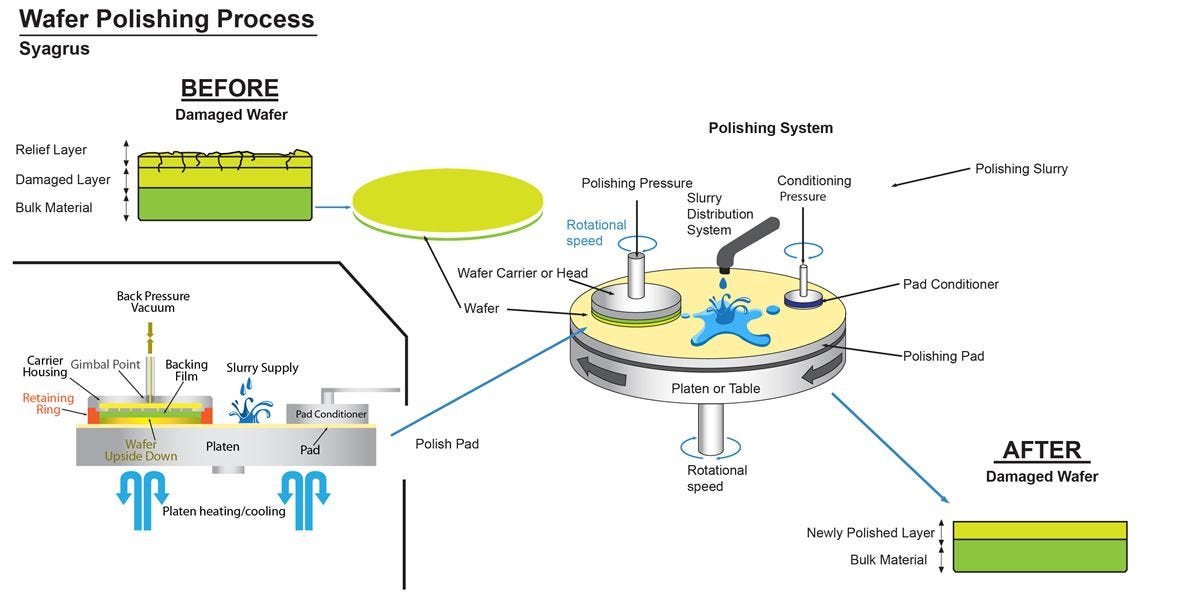
After slicing, wafers undergo Chemical-Mechanical Planarization (CMP), a polishing technique which produces an ultra flat surface. This is done by pressing the silicon wafer against a polishing pad while a slurry of abrasive in a solution flows between the pad and the wafers. The slurry’s is designed to slowly dissolve or oxidize silicon, while the abrasive particles wear down the elevated areas. The result is an atomically smooth, highly reflective surface free of scratches and damage .Properly polished wafers have surface flatness and defect levels in the order of nanometers across an entire 300 mm wafer.
A standard cleaning procedure called an RCA clean is done after this to remove any trace contaminants and defects. First, wafers are soaked in a solution of ammonium hydroxide + hydrogen peroxide + water this solution removes organic matter and particles and oxidizes the remaining contaminants. Next, the wafers go into a dilute hydrochloric acid + hydrogen peroxide bath to remove metal ions. Often, an HF dip is done in between or afterward to strip the thin oxide that forms, along with any trapped impurities.
4. Front-End Fabrication
This front-end part of manufacturing is a repeating series of thin-film deposition, patterning and doping steps that gradually construct the intricate patterns of a chip layer by layer. Since the previous post introduced basic processes like photolithography, etching, doping, and chemical vapor deposition (CVD), let’s talk about thin film deposition.
Thin-Film Deposition: The first step of Front-end fabrication is by adding thin films of various materials onto the wafer via deposition. Key deposition techniques include thermal oxidation, chemical vapor deposition (CVD), atomic layer deposition (ALD), and physical vapor deposition (PVD). Each relies on chemistry to achieve uniform, high-purity films.
5. Back-End Fabrication
The back-end-of-line (BEOL) refers to the creation of the multi-level interconnect network that wires the transistors into functional circuits. While transistors are built in silicon, the interconnect is typically built with metals (for conductivity) and insulating dielectrics (to isolate wires).
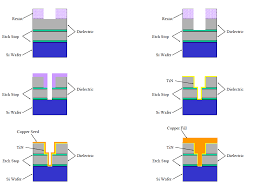
Earlier processes used aluminum metal for wires, patterned by etching. Copper is superior in conductivity, but copper is hard to etch with plasma. The industry solved this by adopting the Damascene process: rather than etching the metal, they etch trenches in the dielectric and then fill them with copper, and use CMP to remove the overfill.
6. Packaging
Once the wafer is fully processed with all circuit layers, the journey isn’t over – the chip must be packaged to the outside world. Now days with high-performance devices, packaging itself has become an extension of manufacturing, with sophisticated 3D stacking and chiplet integration techniques that blur the line between “chip” and “system”.
Before packaging, wafers undergo a wafer sort test. Tiny probe needles touch designated pad areas on each die, and the chips are powered up to run basic functional tests. This identifies any defects. Afterward, the wafer is cut into individual rectangular chips using a diamond saw or laser.
Conclusion
In this post we have covered the process that goes behind the manufacturing of semiconductors. From purifying silica to the packaging semiconductor manufacturing is the combination of chemistry, physics, and engineering at the smallest scales to create the complex technologies that run our world. Each innovation ultimately ties back to controlling how materials form and behave. From refining ultra-pure silicon, to growing flawless crystals, to intricately depositing and etching thin films, every step hinges on chemical reactions and material behavior at micro and nano scales.